
JOY Principles
Cities have always been the habitat of the human spirit—the birthplace of inventions, new forms of collaboration, social interaction, and the ideas that make living a joyful and vibrant experience. To succeed in the future, we need great cities that invest in the common good and the collective human spirit. The JOY Principles is a tool to guide the way.

A Strategic Path to Great Cities
Every good strategy encompasses the key elements in which a project will ultimately be measured. That’s why the great cities of the future—and great city-building projects—will be measured on societal metrics such as how they:
publicly act like a community
connect citizens and make them feel they belong
celebrate their uniqueness and define their identity
foster trust and compassion among their citizens.
Therefore, future city-building strategies must define their vision within this same societal context.
The JOY Principles
City-building projects, in search of different outcomes, must include a different starting point: a powerful societal mission.
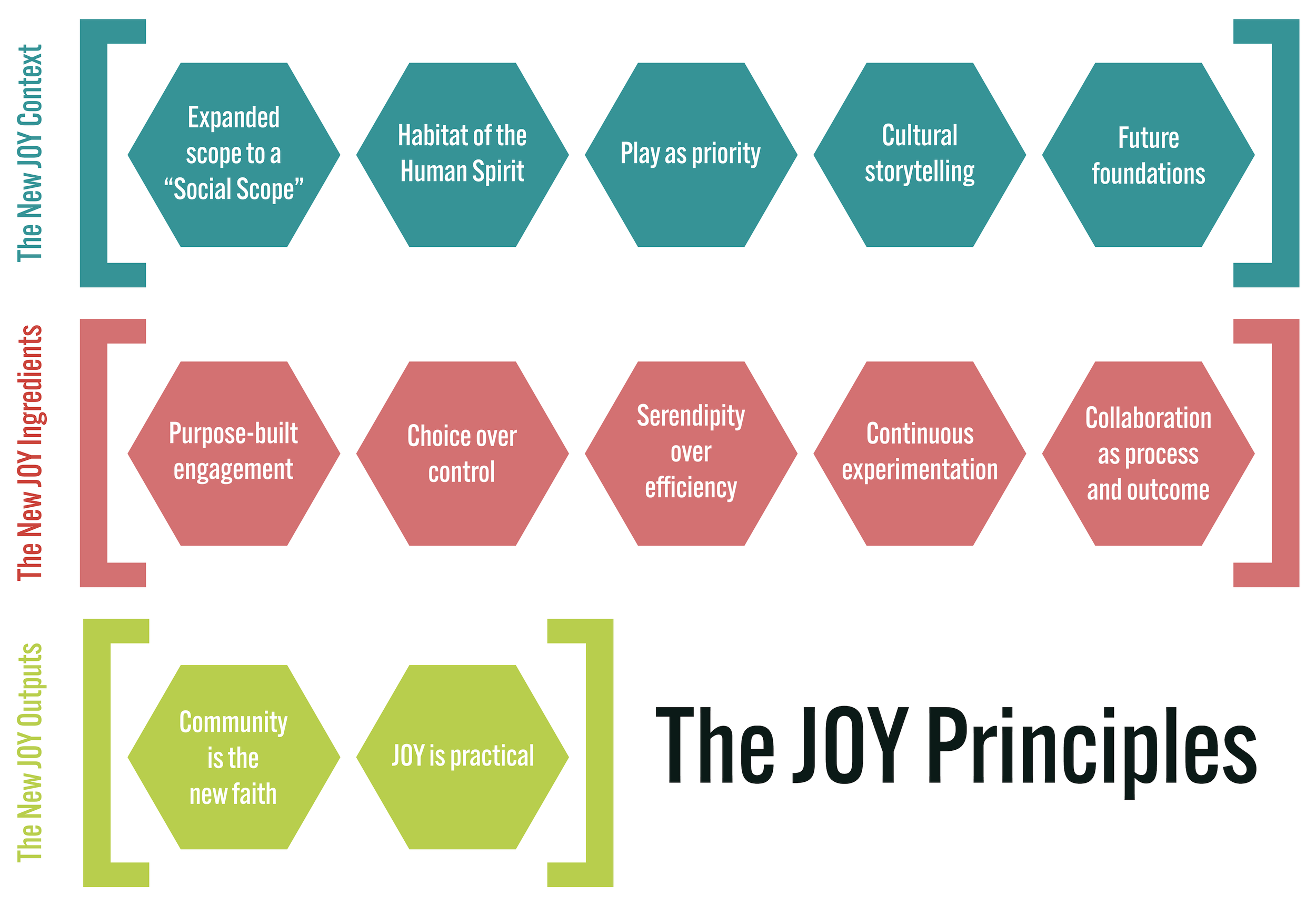
The JOY Principles are a tool for staying the course. These 12 perspective-shifting concepts are discussed in The JOY Experiments and organized into three categories: context, ingredients and outputs.
Together, they make up a unique creative process that keeps city-building projects focused on an all-important societal outcome.
Need help applying the JOY Principles to your city-building project?
Click each drop down to learn more:
-
We should expand the scope of the problems we are trying to solve and goals we are trying to achieve to include the human and community effects of a divided society, epidemic levels of loneliness, depression, isolation, and distrust of institutions. These are the issues that are affecting so many aspects of our communities.
Urban projects should be seen as an opportunity to bring people together. The changes society needs aren’t going to happen at the national level – they will happen in our cities.
-
Cities are the Habitat of the Human Spirit – that source of invention, compassion, and resilience. Throughout history, densely populated and social neighbourhoods have been the place where the sparks of ideas have been shared and borrowed. Athens gave us democracy. Soho gave us the art we still talk about, and New Orleans gave us a whole new form of music.
We’ve stripped away much of the city infrastructure that makes us social for the sake of efficiency. We must aim high and build new forms of Infrastructure for the Human Spirit if we hope to discover the new ideas that will solve the big problems of our age.
-
The relationship between cities and citizens has traditionally followed the Live, Work, Play urban planning model with that order of prioritization. But, given the housing crisis that is affecting every city in North America, and a more mobile work reality for many people, those two urban categories are not as relevant as they once were.
The new opportunity for cities is prioritizing play. Play+Live+Work = Joyful Cities. PLAY, as a city attribute, means connecting citizens and making them feel they belong. It means celebrating a city’s uniqueness and identity, putting inclusiveness into action, supporting an innovative entrepreneurial ecosystem, fostering trust and compassion and offering a vibrancy that helps a generation that is cut out of home ownership feel like fully valued citizens of a city. When we start visioning the future of our city we should first ask, “How does our city play?”
-
Humans communicate through storytelling. Religions are created by storytelling and so are strong and unified communities.
Culture is nothing more than the stories we choose to tell about ourselves. Cities attract what they celebrate through their stories. Public spaces should be viewed as opportunities for telling the stories of a community. When parks and gathering places are filled with generic and cosmetic expressions of art it is a missed opportunity to create meaningful collective joy for a city.
-
Young people need to be engaged by their community or they will assume their future is somewhere else. They should feel they can change the world without having to leave home. Youth should also feel they are being supported and mentored in following their dreams. There should be accessible public spaces that support optimistic dreams.
From a business development perspective, home grown talent is much more loyal to a community than imported talent. They are more likely to support local social issues and create businesses that really put roots into the community.
The New JOY Context
-
Public space once served as a retreat from city life. Now, with so many people alone or withdrawn, we need public spaces that are purpose-built to engage us. The reality is that public spaces must compete with home entertainment systems, big backyards and cellphones. And, while those things command our attention, they also leave us lacking the meaningful connections and a sense of belonging that promotes better mental health.
Park benches have their place, but for the most part we don’t need more places to sit - we need places that are free and playfully collaborative.
-
Citizens should have choice in how they participate in public activities - whether that be choosing the role they play in a game or how they interpret a piece of public art. Just like when we were kids in the playground – the best games where the ones in which we made parts of the rules up. We felt they were our games.
When the “rules” of public play are intentionally vague or incomplete, people start to play with their city, which increases a sense of ownership, control and pride in the community.
-
Cities have been designed and built for efficiency – especially as it relates to cars and our economy. In this model, similar activities and ways of living in a city were segregated into zones. But the places in a city that become our favourite are the ones that offer pleasant surprises.
That’s serendipity – defined as “unexpected and fortunate discoveries”. Sometimes we all need a jolt of the unexpected and the fortunate. It forces us to improvise and find the joys we didn’t know we were looking for! It brings us together and turns strangers into neighbours.
Moments of serendipity should be an intentional ingredient of urban design.
-
Limiting risk is a good thing. But limiting all risk is the biggest risk of all, especially in the case where change is pushed upon our cities. Climate change alone will demand huge adaptations – there is no avoiding that. An attitude of experimentation must be part of our urban development process in which new ideas are acted upon, results analyzed and followed by further experimentation in a repeated fashion.
Most importantly, citizens must also adopt an attitude of accepting experimentation. That is how we get to somewhere better together. No city or person is immune to the need for experimentation.
-
Much of the focus of JOY is to build optimistic and collaborative cities. The funny thing about collaborative outcomes is that they require a collaborative process involving government, the private sector, institutions, and social organizations.
The idea that change or innovation happens because of one strong leader simply isn’t the reality. During Covid we use to say, “We’re in this together.” The same is true about getting to our future destinations.
The New JOY Ingredients
-
Society has been slowly abandoning its faith and trust in traditional institutions and leadership models. People are looking for alternatives.
Joyful cities give citizens the structure and sense of place to truly put their faith in community, and when that happens, it adds a new level of collective energy to a city that leads to social and economic prosperity.
-
The experience of joy in our cities is the path towards civic compassion, optimism and a better future. It allows us to step out of our assumptions and feel a sense of open-ended possibility and purpose. It feeds the human spirit, making us more inventive resilient and tolerant.
Facing grim problems with grim determination isn’t sustainable - JOY is.
The New JOY Outcomes

The Outcomes of JOY
The JOY Principles offer a framework for examining our problems and opportunities differently and prioritizing infrastructures that bring us together, ones in which the human spirit can create moments of collective joy. This framework can be applied to many of our most important issues with meaningful outcomes. For example:
JOY can boost the economy: Today’s economy runs on ideas, invention, and the people who create them. A city’s ability to attract creative talent through vibrant living, collaborative spaces, and a lifestyle that blends work and play will determine its economic future.
JOY can make housing more affordable—and fun: Joyful cities redefine what it means to live in a “smaller” house by devoting urban public space to playful participation. In this model, neighbourhoods are the best amenity for a home. The city becomes everyone’s communal backyard.
JOY can make inclusiveness possible: As much as cities strive for inclusiveness, the reality is that money usually gets in the way. The true metric for determining inclusivity and quality of life is how much joy can be experienced in a city for free.
JOY can improve mental health: Joyful cities prioritize the need for social connection and the optimism that comes out of collaborative moments of play. In these moments, strangers become neighbours. Shared ideas become invention and the engines of prosperity and a collective vision for the future.
JOY reduces political and social division: Joyful cities create more united citizens by moving people out of seclusion and into collaboration. Unity and a collective vision for the future also facilitate experimentation, since citizens are more willing to allocate tax dollars to projects that create collective value.